• Skip to primary navigation
  • Skip to main content
Center for Applied Research Solutions

Center for Applied Research Solutions

  • About Us
    • Who We Are
    • Our Team Members
    • Our Clients & Partners
    • Our Projects
    • Join Our Team
  • What We Do
    • Our Capabilities
    • The Collaborative
    • CARS Learning Exchange
    • Featured Article
  • Areas of Focus
    • Behavioral Health
    • Crisis Response & Recovery
    • Student & Staff Wellbeing 
    • Community Wellness
    • Featured Article
  • Request a Call
  • Contact Us

Life After Loss

Hosted by the Center for Applied Research Solutions team and made possible through a Grief Reach Grant from the New York Life Foundation & the National Alliance for Children’s Grief 
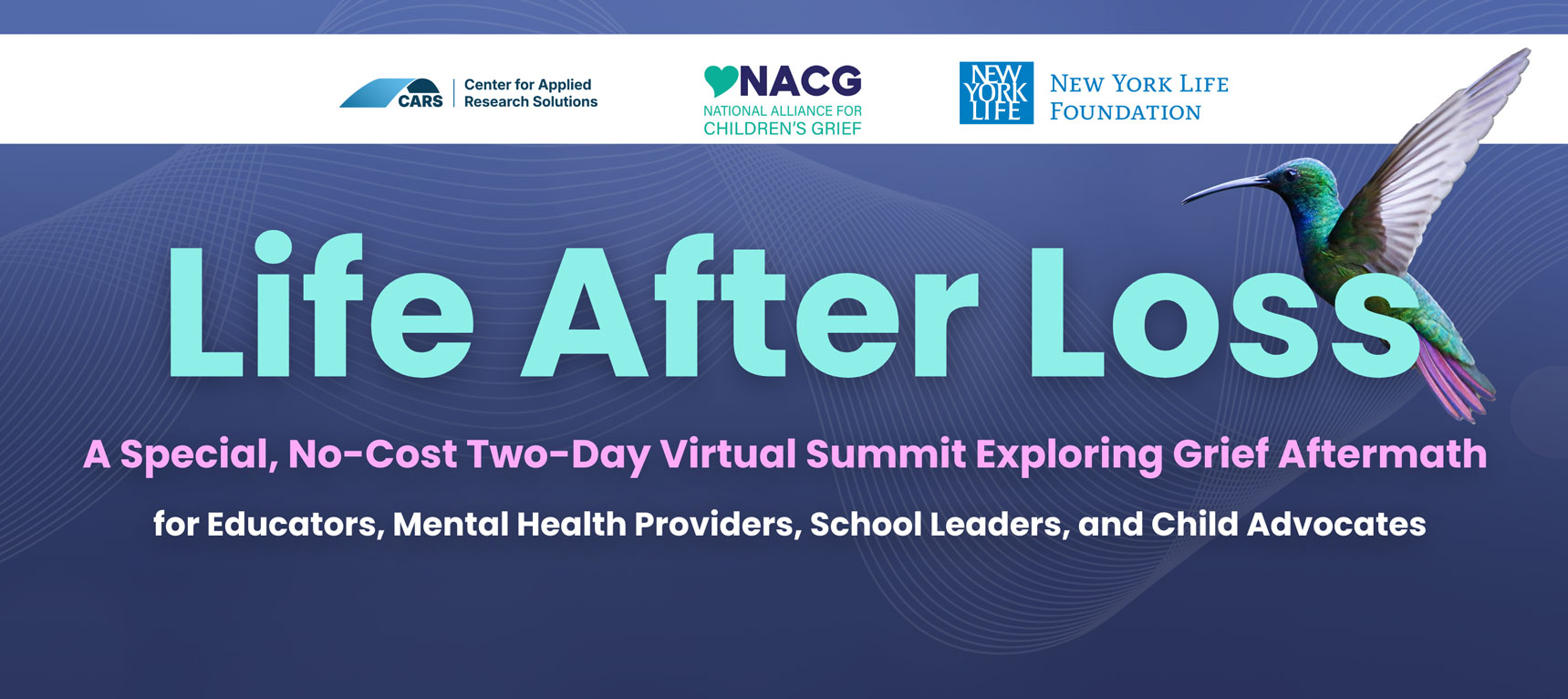
Thank you to the 1,723 people who joined us at Life After Loss on 1/22 & 1/23/26 — together we created community, belonging, rich learning, and supportive spaces to skill ourselves in holding grief aftermath.

January 22, 2026 Main Summit

January 23, 2026 Special Space for Providers’ Grief Processing

We gathered to create and engage in rich learning that focused on grief work we often miss: the long-term experiences, processes, and impacts of grief for young people, and how we as providers, systems leaders, and culture builders could skill ourselves up to attend to the aftermath with as much attention as the acute. 

Day 1 – Thursday, January 22nd focused on the aftermath: the weeks, months, and years after big events, and how grief could include both experiences of joy and celebration as well as isolation and deep sadness. 

Importantly, Day 2 – Friday, January 23rd focused on provider processing. Often, providers—whether clinical providers, systems leaders, or educators—held their own grief metabolization on pause while supporting children and youth in acute need. 

Through meaningful workshops, panels, keynotes, and discussion forums that focused on grief aftermath, we supported professionals who work with young people to feel efficacious, empowered, and energized with strategies and skills to support young people in navigating all that comes with aftermath coping and healing: addressing trauma and grief activation, memorialization and commemoration, interrupting isolation and disenfranchised grief, and implementing structural strategies to ensure ongoing, responsive care. 

We think that the point is to pass the test or overcome the problem, but the truth is that things don’t really get solved. They come together and they fall apart. Then they come together again and fall apart again. It’s just like that.
The healing comes from letting there be room for all of this to happen: room for grief, for relief, for misery, for joy.

Pema Chödrön

Our Experience

January 22, 2026 – Main Summit

See full bios of speakers below 

9:00 a.m. – 2:00 p.m. PT/ 12:00 p.m. – 5:00 p.m. ET

Watch the whole way through or jump to different chapters of this video, listed below if you’re looking for a specific session using the timestamps below:

0:00 – Introduction Leora Ya’Acova Wolf-Prusan
30:23 – “We Begin Whole, and We Can Be Whole Again” Teddy McGlynn-Wright
01:23:23 – “When the Personal is Professional: Leaning in and Leaning Out” (add) – With Amy Castellanos, Taj Jensen, Shefa Obaid & Juan Carlos Ocun
02:05:55 – “I am in it and I am from it” Community Grief Aftermath” Panel (add) With Desralynn Cole, Meghan Graham, Scott Lindstrom & Rosaura Orengo-Aguayo and moderated by Leora Wolf-Prusan
02:58:33 – “Finding Focus in Griefscape” Dr. Zelana Montminy
03:13:50 – “Integration and Closing” Leora Ya’Acova Wolf-Prusan
03:24:06 – “A Closing Practice: METTA” Oriana Ides 

9:00-9:30 a.m. PT/ 12:00 p.m. – 12:30 p.m. ET

9:30-10:15 a.m. PT/ 12:30 p.m. – 1:15 p.m. ET

Join Teddy McGlynn-Wright for a moving talk on the Integrative trauma and healing framework, belonging, repair and what it can feel to yearn and organize for wholeness.

10:25 am – 11:25 am PT/ 1:25 p.m. – 2:25 p.m. ET

We’re thrilled to offer participants six incredible workshops to learn, metabolize, process, and inquire into our grief aftermath needs and know-how.

During the summit, you’ll be invited to select one workshop of your choice:

  1. COVID-19 Meaning Making with Oriana Ides 
  2. Culturally Responsive Suicide Postvention with Tina Rocha
  3. Creating the Container – Holding Space with Leora Wolf-Prusan 
  4. Writing Our Way Through the Aftermath with Niki Magtoto
  5. Renegade Grief – Embracing grief as a fundamental human experience and a potential pathway to a more soulful life with Carla Fernandez
  6. Three Lenses of Childhood Grief and Bereavement with Angela Castellanos

11:30 a.m. – 12:15 p.m. PT/ 2:30 p.m. – 3:15 p.m. ET

What does it feel like to be both experiencing and leading the response to grief aftermath? How might that experience impact educators, school leaders, and providers for recovery and renewal? Join leaders from school sites, districts, systems and mental health fields as they reflect on the nuances of leading through grief when we ourselves are grieving.

With Amy Castellanos, Taj Jensen, Shefa Obaid & Juan Carlos Ocun and moderated by Niki Magtoto.

12:30 p.m. -1:15 p.m. PT/ 3:30 p.m. – 4:15 p.m. ET

From Minneapolis to Oakland to Butte County to North Carolina to Puerto Rico, join community leaders who are also mental health providers to reflect in a powerful discussion about the experience of leading communities through grief aftermath while in it themselves.

With Desralynn Cole, Meghan Graham, Scott Lindstrom & Rosaura Orengo-Aguayo and moderated by Leora Wolf-Prusan.

1:25 p.m. – 1:45 p.m. PT/ 4:25 p.m. – 4:45 p.m. ET

Dr. Zelana Montminy closes our powerful day with reflections on the psychology of resilience and reinvention and how to hold it all together while falling apart. Through poetry, writing, and her own testimony, Dr. Z’s words and work provide us a space to integrate and inquire.

Bonus! Participants who stay the entire summit on Day 1 will be entered in a raffle to receive Dr. Z’s most recent book, Finding Focus, which in her own words is “a book about coming home to yourself.”

1:45 p.m. – 2:00 p.m. PT/ 4:45 p.m. – 5:00 p.m. ET

Main Summit Resources

  • Life After Loss Main Summit Slides
  • “We Begin Whole, and We Can be Whole Again” – Keynote Slides

Meaning-Making Workshop Materials

  • COVID-19 Meaning-Making Slides
  • Culturally Responsive Suicide Postvention Slides
  • Creating the Container – Holding Space Slides
  • Writing Our Way through the Aftermath Slides
    • Writing Our Way through the Aftermath Worksheet
  • Renegade Grief Slides
    • Renegade Grief Worksheet
  • Three Lenses of Childhood Grief and Bereavement

Day 2 – January 23, 2026
Special Space for Providers’ Processing

9:00 a.m. – 12:30 p.m. PT/ 12:00 p.m. – 3:30 p.m. ET

Watch the whole way through or jump to different chapters of this video, listed below if you’re looking for a specific session using the timestamps below:

0:00 – Introduction – Oriana Ides 
14:50 – “Grief Guideposts to Personal & Collective Freedom” Candice Rose Valenzuela
45:00 – Panel Discussion “Care Without Collapse: The Toll and Truth of Helping”
01:38:20 – “The Shape of Grief as a Fight for Life”
02:23:27 – “Art Based Integration” Oriana Ides
02:40:00 – Conclusion – Oriana Ides 

9:00 a.m. – 9:15 a.m. PT / 12:00 p.m. – 12:15 p.m. ET

Oriana Ides opens Day 2 inviting us to explore what it takes for us to notice, name, and attend to our holistic experience as service and care providers and to imagine what is possible for us when we are able to access noticing, naming and attending to our own grief and bereavement experiences while helping others’.

9:15 a.m. – 9:40 a.m. PT/ 12:15 p.m. – 12:40 p.m. ET

Without cultural acknowledgement or support, it often feels safer to minimize, suppress or avoid the grieving process. Yet our willingness to grieve directly correlates to our capacities for joy, love, connection and getting free. Join Candice Rose Valenzuela for this session that explores the gifts that arise from grieving well; guideposts that lead the way to personal and collective freedom.

9:50 a.m. – 10: 40 a.m. PT/ 12:50 p.m. – 1:40 p.m. ET

Jerica Coffey, Ebony Johnson & Jesus Solorio, moderated by Oriana Ides, delve into the profound, often invisible, toll that helping professions and caregiving roles exact on us. This discussion provides a candid examination of burnout, emotional exhaustion, and the systemic challenges faced by those dedicated to the grief healing of others.

10:45 a.m. – 11:30 p.m. PT/ 1:45 p.m. – 2:30 p.m. ET

In this somatics workshop, join Sue Kuyper to practice being with our grief as a way to move towards life and generate body-up trust as a resource. Somatics is a transformational path that gives us access to more of who we are through sensations in the body. Embodied practice is experiential, inside a container of trust that includes consent, choice, and practicing with disability justice principles in mind.

11:30 a.m.- 11:50 a.m. PT/ 2:30 p.m.- 2:50 p.m. ET

In this expressive arts workshop, participants will create visual “maps” that trace the inner landscape of grief—its challenges, its resilience, and the surprising places where light still enters. Through guided art-making, reflection, and gentle discussion, we’ll explore what it means to navigate personal storms while attending to the openings that support healing. No artistic experience is required—only curiosity, honesty, and a willingness to see yourself in new ways.

11:50 a.m. – 12:00 p.m. PT/ 2:50 p.m. – 3:00 p.m. ET

“The healing comes from letting there be room for all of this to happen.”

⎯ Pema Chödrön

Provider Processing Space Resources

  • Life After Loss Provider Processing Space – Main Session Deck
  • Grief: Guideposts to Personal & Collective Freedom Keynote Slides
  • Care without Collapse Panel Slides
  • The Shape of Grief as a Fight for Life Slides
  • Mapping the Storms: Art-Based Integration Slides

Grief Aftermath Resources

After the L.A. Fires: Understanding and Coping with Grief and Emotional Recovery

View Resource

Teaching While Grieving a Death – National Council of Teachers of English – Mandie B. Dunn

View Resource

Teaching Through the Trauma of Student Loss | EdSurge News

View Resource

Teachers as caregivers of grieving children in school in the post-COVID-19 era

View Resource

School Crisis Healing Resources

Leaning In and Leading Out to Renew

View Resource

Honoring Grief – Invitations for Educators to Allow & Embrace Our Own Lived Grief Experiences

View Resource

Leading with Courage, Care, & Connection

View Resource

Creating and Holding Space for Ourselves and Each Other After Student Death

View Resource

Grief Leadership Recovery and Renewal After Wildfire

View Resource

Our Right to Grieve: Grief-Informed Recommendations and Resources

View Resource

Faculty

Lead

Leora Wolf-Prusan Ed. D., (she/her), is the Managing Director of the Student and Staff Wellbeing program stream at the Center for Applied Research Solutions. She currently serves as the Project Director for the Statewide Technical Assistance Center for the California Commission for Behavioral Health’s BHSSA grantees. Formerly, she served as the Project Director for the School Crisis Recovery & Renewal project, the School Mental Health field director for the Pacific Southwest Mental Health Technology Transfer Center (MHTTC), and the national field director of a SAMHSA initiative (ReCAST). Her work is motivated by and dedicated to educators and youth who envision schools as a platform for community and connection. 

Niki Magtoto,  M.A. (she/her), is a Senior Project Manager at the Center for Applied Research Solutions, (CARS) and an accomplished leader focused on creating new opportunities for young people. As a 3rd-generation San Franciscan, she dedicated 10 years to the San Francisco Unified School District and County Office of Education, providing strategic leadership in comprehensive teacher recruitment and retention, designing and implementing programs for students dealing with parental incarceration and housing instabilities, and postsecondary pathway supports as an Educational Policy Analyst, before joining CARS. 

Oriana Ides, M.A., APCC, PPS (she/hers), is a School Mental Health Training Specialist in the Student and Staff Wellbeing program stream at the Center for Applied Research Solutions. Oriana has extensive experience working with young people across various life stages, from elementary school through college, as well as care providers and families serving in various roles such as school and community-based therapist, educator, school leader and program director. She is committed to generating equity within school structures and policies by focusing on evidence-based mental health techniques and institutional design. Her work to forge a more just world is motivated by and dedicated to Amilca Ysabel Mouton Fuentes. 

Guest Faculty

Angela Castellanos, LCSW, PPSC, ASC, (she/her) is a Senior Training Specialist at the Center for Applied Research Solutions (CARS). Angela Castellanos is dedicated to advancing trauma-informed practices that strengthen organizational health and foster inclusive, supportive environments. With extensive experience in behavioral health, school mental health, and crisis response, Angela brings both strategic vision and deep empathy to her leadership. Angela’s professional journey has been profoundly shaped by her work supporting families through grief and personal losses. These experiences have not only expanded her understanding of healing and resilience but have also deepened her commitment to creating spaces where individuals and communities feel seen, heard, and supported. Her background in clinical social work, suicide prevention, and threat management underscores her ability to navigate complex challenges with compassion and clarity. Her resilience and dedication stem from both personal and professional experiences of loss, which have provided her with a unique perspective on the human capacity to heal and grow. This perspective informs her approach as a wellness coach and leader, where she integrates principles of balance, empowerment, and self-care into every interaction.

Amy Castellanos, B.S. (she/her), is a systems renewal facilitator whose work focuses on the long-term impacts of grief on leaders and communities. As the founder of Moving The Soul, she supports school districts and public agencies in crisis recovery, organizational change management, and relational leadership. Amy has over 15 years of experience in postvention and healing-centered systems change. She holds a Public Health degree, a Project Management Professional (PMP) certification, and advanced certifications in grief, resilience, and healing-centered environments. She dedicates her work to the youth looking for a lifeline in the adults who serve them.

Amy was a School Crisis Recovery & Renewal 2023-2024 Leadership Fellow and a co-author of Leaning In And Leading Out To Renew – A Guidebook from and for School Leaders Navigating the Personal & Professional Intersections of Polycrisis (2025).

Candice Rose Valenzuela, MA, YT-200 (they/them/she/her),proudly identifies as Black, Mexican Indigenous Descent, Queer, Nonbinary, poor and working class allied. As a former foster youth, Candice utilizes their personal experiences of marginalization, survival and healing to inspire transformative thinking, creative problem solving and social change in the communities they serve. 

Against many odds, Candice earned a Bachelor of Arts in Humanities at Loyola Marymount University, a teaching credential from Alliant University, a Master of Arts in East-West Psychology  and a Masters in Integral Counseling Psychology at the California Institute for Integral Studies. Candice is certified as a trauma-informed yoga and mindfulness instructor through the Niroga Institute, and has training in Mesoamerican indigenous healing practices through Ancestral Apothecary in Oakland, CA.

Candice has worked at the intersections of education, healing and justice for over 20 years. Candice believes that ancestral, community and ecological healing are the most urgent issues of our time. They coach systems leaders, offer healing space and facilitate professional development at justice driven institutions throughout the nation. When they are not working, Candice enjoys sharing their enthusiasm for nature with their 9-year daughter. 

Join their newsletter:https://candicerosevalenzuela.substack.com/ Contact them through their website: www.candicerosevalenzuela.com 

Carla Fernandez, B.A. (she/her), is an impact strategist, facilitator, and writer exploring how circles of people come together to shift culture when a new status quo is called for. Her first book, Renegade Grief: A Guide to the Wild Ride of Life After Loss, was published by Simon & Schuster, debuted as a #1 New Release on Amazon, and has been featured by NPR, The Guardian, and The New York Times. She is the cofounder of The Dinner Party, a national network of peer-support circles for young adults navigating loss, named on Buzzfeed as the #1 thing to do when grieving. Beyond her work in grief, Carla leads her Community Design Studio, partnering with foundations, governments, and impact networks to foster shared visions, map pathways to action, and rewire cultural narratives. She has been named an Eames Institute’s Curious 100, is a Senior Fellow with USC’s Annenberg School Innovation Lab, and a Catherine B. Reynolds Foundation Scholar in Social Entrepreneurship at NYU. She divides her time between the Hudson Valley and Joshua Tree.

Desralynn Cole, CPPM (she/her), leads Oakland’s ReCAST program through the City’s Human Services Department, where for the past four years she has funded and supported a wide range of community-based programs that use trauma-informed strategies to help residents heal after violence, loss, and collective stress. Her work in Oakland focuses on strengthening community healing networks, improving trauma response, and building public systems that prioritize care, connection, and culturally rooted support. Her leadership in Oakland is deeply shaped by the five years she spent with Minneapolis ReCAST, where she helped build the very approaches she now expands in Oakland. During her time in Minneapolis, she designed and implemented community-centered strategies such as mapping neighborhood mental health assets, coordinating community grantmaking initiatives, and training advocates and community interventionists to respond to traumatic events with compassion, cultural grounding, and practical support. These efforts strengthened the city’s grassroots capacity for healing and resilience, especially during moments of widespread grief. 

That work became even more urgent in 2020, when she helped mobilize a community-led response following the murder of George Floyd. Under her direction, more than 150 volunteers supported over 8,000 residents in three months—demonstrating the power of community activation to bridge critical gaps in public health systems. The strategies she helped shape in Minneapolis now serve as the foundation of her work in Oakland, guiding how she uplifts community partners, centers lived experience, and invests in trauma-informed healing across neighborhoods. Desralynn is guided by a belief in meeting people where they are, partnering across systems, and ensuring communities have real access to culturally grounded behavioral health support. She leads with a deep commitment to staying close to the people her work is meant to serve, even while navigating the complexities of city systems.

Ebony Sinnamon-Johnson, MA’s (she/her), path is grounded in the integrity of Spirit and guided by her ancestors. Her calling is to be of service to those targeted by the brutality of oppressive systems. As a Black woman, Ebony prioritizes her advocacy, organizing, teaching, consulting, and healing guidance work to uplift Black people and Black communities. In addition to supporting marginalized people to navigate, resist, and heal from structural violence, Ebony recognizes this work is incomplete without asserting methods of accountability for abusive systems and empowerment for those harmed. Ebony has worked across a variety of institutional settings, including public education, child welfare, community-based mental health, and juvenile justice. Her practice has always been accompanied by efforts to partner with those most impacted and their allies to develop and implement protocols of systemic accountability to address issues of bias and discrimination. A hallmark of Ebony’s practice is challenging the status quo and inspiring people to initiate and create healthier ways of existing. Principles from Transformative Justice, Disability Justice, and the Black Radical tradition, like self-determination, intersectionality, collective empowerment, sovereignty, and love, inform her perspective and guide her approach.

Jerica Coffey, MA,  (she/her) is an educator, program director, and facilitator dedicated to nurturing critically conscious, healing-centered learning communities with over 25 years of experience. She currently teaches English and Ethnic Studies at Coliseum College Prep in East Oakland, where she centers student voice, cultural identity, and social justice as the foundations of academic empowerment. In addition to her classroom work, Jerica is committed to shaping the next generation of educators. Through her role with the City College of San Francisco’s Teacher Preparation Program, she supports aspiring teachers in developing practices rooted in equity, reflection, and cultural humility. Her mentorship emphasizes understanding lived experience, recognizing patterns of activation, and cultivating trauma-informed pedagogies that honor student and educator wellness. 

Jerica also serves as the Founder and Director of the Liberation Learners Early College Program. In this role, she leads the design and implementation of a community-centered early college model that blends critical literacy, college readiness, and identity-affirming instruction. Her leadership focuses on expanding access, uplifting community assets, and ensuring that students—particularly those from historically targeted backgrounds—enter higher education with confidence, agency, and support. Across all her work, Jerica is known for her grounded presence, relational approach, and commitment to transforming educational spaces into places of healing, empowerment, and liberation. Her facilitation weaves together trauma-informed practice, culturally responsive pedagogy, and educator wellness, helping teams and institutions move beyond survival toward collective flourishing.

Jesus Solorio,  LMFT (el, he, him), identifies as Xicano and was born and raised in Los Angeles (Tongva territory) by migrant parents from Michoacán (Purépecha territory). Jesus earned his Master’s degree in Counseling Psychology with a concentration in Community Mental Health from the California Institute of Integral Studies. He is the owner of the group private practice, Ollin Marriage & Family Therapy, Inc. Prior to that, he has worked in various settings as a therapist, lead clinician, supervisor, and program manager. These include Instituto Familiar de La Raza, La Familia Counseling Service, the Community Mental Health Certificate Program at City College of San Francisco, and Kaiser Permanente. Jesus is a member of the Council of 13 for the Institute of Chicana/o/x Psychology and teaches in the Department of Counseling at San Francisco State University. Jesus’ work is culturally responsive, rooted in social justice, trauma-informed, strength-based, and is strongly infused by an indigenous worldview and liberation psychology. 

Jesus honors and recognizes his mentors and teachers along the way, beginning with his mother and older sisters who have taught him lessons in strength, resiliency, love, and humility. As a therapist, his mentors include Maestra Concha Saucedo, Dr. Sal Nuñez, and Tio Samuelin Martinez, who have all shown him what it’s like to work from a place of authenticity and love while anchoring in indigenous ways. He has apprenticed with Dr. Sal Nuñez in Medicinal Drumming Praxis and has been trained in Chicanx Affimative Therapy, EMDR, and Somatics and Trauma from Generative Somatics. He is a Mexica Mitotiani and Huehuetero (Mexica Dancer and Drummer) with Calpulli Nanahuatzin.

Juan Carlos Ocun, PhD Candidate, (he/him), is the principal of Benito Juarez Community Academy, a vibrant Chicago Public Schools high school in the heart of Pilsen. For more than 25 years, he has dedicated his career to the Juarez community—serving as teacher leader, Dean of Students, Assistant Principal, and now Principal—always grounded in a belief that every young person deserves an excellent, empowering education. 

Under his leadership, Juarez has undergone a powerful transformation. In 2010, the school shifted from traditional grading to a standards-based system to more accurately reflect student learning and growth. This change improved student outcomes and mindsets, yet Juan Carlos knew the work of equity required deeper innovation. In 2016, Juarez became one of Chicago’s pioneers in Competency-Based Education, redesigning learning to meet the academic, social, and emotional needs of all students. Today, Juarez is home to progressive, student-centered programs where young people construct knowledge through meaningful, relevant, and engaging experiences. 

As a result, Juarez stands as a thriving neighborhood high school—a school of choice, a leader in educational innovation, and a true center of community for Pilsen’s families. 

Juan Carlos recently earned his Illinois Superintendent Endorsement and is currently in his third year of a Ph.D. program in Educational Policy at the University of Illinois at Chicago. His work is driven by a simple but powerful belief: schools can transform when leaders, educators, families, and students imagine boldly and act courageously together.

Meghan Graham, LCSW, LCAS-A (she/her), was born and raised in Western North Carolina and calls the Appalachian Mountains home.  After receiving her master’s in social work from Tulane University, Meghan stayed in the Greater New Orleans area for ten years supporting trauma-informed and culturally responsive programming across systems with a focus on community wide crisis response efforts, suicide prevention, and restorative practices.  Meghan left New Orleans to support the National Center for Child Traumatic Stress at the Duke School of Medicine to serve as a liaison between SAMHSA and NCTSN (National Child Traumatic Stress Network) grant funded sites across the country supporting youth, families, and communities impacted by trauma. The mountains were calling Meghan home, and she returned back to Western North Carolina where she was living when Hurricane Helene hit her community, her home.  Meghan was exactly where she was meant to be and has continued to support the mental health response efforts for continued collective healing in her community. Meghan currently serves as the Program Coordinator for the Terrorism and Disaster Program with the National Center for Child Traumatic Stress based at UCLA, continuing her work to advance trauma-informed disaster response efforts and serves as a co-chair for the Suicide Prevention Community of Practice. 

Rosaura Orengo-Aguayo, PhD, (she/her/ella), is a Professor and bilingual (Spanish and English) licensed Clinical Psychologist at the National Crime Victims Research and Treatment Center, within the Department of Psychiatry and Behavioral Sciences, at the Medical University of South Carolina (MUSC). She completed a BA in Psychology at the University of Puerto Rico, an MA and PhD at the University of Iowa, and an NIMH postdoctoral fellowship in traumatic stress research at MUSC. Her research focuses on addressing mental health disparities among underserved, trauma-exposed populations (specifically Spanish-speaking youth and families) through innovative implementation and dissemination methods, including telehealth. She also has an active program of research focused on the cultural and linguistic adaptation and international dissemination of trauma-focused treatments, particularly within post-disaster and low-resourced contexts. 

Dr. Orengo-Aguayo directs the Puerto Rican Center for Trauma Training & Research, a SAMHSA-funded program aimed at capacity building, resource sharing, technical support, and training in evidence-based trauma-focused interventions, and telehealth as a service delivery modality. Her team has published several seminal publications on the impact of disasters on youth mental health (JAMA Network Open), and the implementation and dissemination of in-person and telehealth delivery of Trauma Focused Cognitive Behavioral Therapy (TF-CBT) in Latin America and US (American Psychologist). She is a co-author in the first telehealth manual available in Spanish (Manual de Telesalud Mental). She is a nationally certified trainer in Trauma Focused Cognitive Behavioral Therapy (TF-CBT), Psychological First Aid (PFA), and Skills for Psychological Recovery (SPR), and has expertise in Acceptance and Commitment Therapy (ACT). Dr. Orengo-Aguayo co-directs the World Changers Lab at MUSC & Puerto Rico, with Dr. Regan W. Stewart, whose mission is to “change the world, one child at a time.” She is passionate about mentoring the next generation of mental health professionals to be world changers who lead with cultural humility and values-driven behavior.

Scott Lindstrom, PPS Psych, NHA Advanced Trainer/Coach (he/him), is a Co-Coordinator of School and Community Wellness for the Butte County Office of Education (BCOE) and a Certified Advanced Trainer for the Nurtured Heart Approach (NHA). In his current role, he co-leads a school-based mental health team of clinicians and Wellness Coaches who serve students across multiple school sites in Butte County. He is focused on growing school-based mental health providers and teams and expanding access to trauma-informed, relationship-centered mental health supports. His work is rooted in a deep belief that every person deserves to feel seen, valued, and to know the incredible gift that they are to the world. Before joining BCOE to help guide recovery efforts following the Camp Fire, Scott served for more than 30 years as a school psychologist and coordinator of student support programs in Chico Unified School District (Chico USD). Most importantly, Scott is a devoted husband, proud dad, enthusiastic grandpa, and friend to the many beloved people whose lives touch his.

Shefa Obaid, MSc. (she/her), is a regional expert in mental health and trauma with over ten years of field and technical experience supporting communities affected by conflict across the Middle East. She has worked with leading organizations such as IRC, UNFPA, and Humanity & Inclusion, where she led the development of psychosocial support programs, clinical supervision systems, capacity-building for practitioners, and evidence-based interventions for survivors of violence and displacement. Shefa combines academic expertise from the University of Toronto and the University of Phoenix with extensive professional practice in high-risk case management, trauma recovery, and strengthening protection systems for vulnerable populations. She is known for her holistic, human-centered approach focused on resilience, healing, and empowering individuals and institutions across the region.

Sue Kuyper,  LCSW (she/her), is a 50-something cis white queer bilingual (Spanish/English)  politicized somatic healer and therapist, licensed clinical social worker and organizational consultant who has been working in crossroads of social movements, community-based organizations and healing for the past 30 years primarily in the Mission District in San Francisco, Oakland and Guatemala.  She offers an in-depth multicultural, internationalist and multidisciplinary perspective with expertise in community worker/organizer vicarious trauma, transnational families, immigration trauma and transforming embodied whiteness. Sue has been shaped by generative somatics, healing justice, anti-violence and youth-serving organizations, decolonial spiritual communities, international solidarity work and being a single mother to two “adultish” people. She lives and works on unceded Chochenyo and Muwekma Ohlone homeland also known as Oakland, California.

Taj Jensen, M.Ed. (he/him), is a seasoned education professional with 25 years of experience in public education. His unwavering dedication to improving educational outcomes for underserved and marginalized communities has earned him a well-deserved reputation as a transformative leader. Currently, Taj serves as the Director of Student Supports for Tacoma Public Schools in Washington State, where he oversees a broad portfolio of programs, including McKinney-Vento (homeless education). Foster Care Education, Federal Programs, Multilingual and Refugee Education, Special Education, and Indian Education.  His work reflects a deep commitment to equity, access, and advocacy for students and families facing systemic barriers.

Beyond his administrative leadership, Taj brings a unique perspective shaped by personal and professional experiences of loss and resilience. He believes that grief, while deeply challenging, can also be a catalyst for empathy-driven leadership and systemic change. When the “dark night of the soul” is embraced and leaned into, beauty often emerges in profound and unexpected ways—illuminating new paths as we navigate the journey of grief. 

Taj is also a proud father of three soulfully vibrant young women and husband to a beautiful human being, grounding his leadership in love, family, and purpose. His insights focus on how leaders can transform adversity into purpose, fostering hope and opportunity for those they serve. 

Teddy McGlynn-Wright, MSW (he/they)  is a Belonging-Based Facilitator, politicized healer and award-winning professor, formerly of the UW School of Social Work. He currently directs a trauma-informed schools project in New Orleans, LA. When working with clients, (individuals and organizations), Teddy uses a body-based (or somatic) approach to healing and transforming systems that break people, families and communities.  His three main areas of work— teaching, trauma-stewardship, and facilitation, inform and are informed by one another. 

Recognizing that all interpersonal violence happens in the context of structural violence, Teddy takes a body-based approach to healing and clearing secondary trauma in individuals and collectives, whether the trauma is racialized or gendered, interpersonal or institutional. Teddy supports those on the frontlines of anti-violence movements including domestic violence and sexual assault advocates, anti-racist organizers, and prison abolitionists. He primarily works with values-based organizations/clients, supporting them to align their values with their actions – grounded in what’s now to shape what’s next. 

Tina Rocha (she/hers), MSW, PPSC, is a Technical Assistance Specialist at the Center for Applied Research Solutions. Prior to joining CARS, she’s had the privilege of spending years in direct service roles and in vulnerable spaces with youth in education, including alternative education institutions, who’ve experienced unimaginable trauma and unexpected loss that fortified her commitment to making schools a safe haven for all youth. She has a Master’s Degree in Social Work where she’s explored crisis response and suicide postvention, and her current area of focus as a Doctoral student of Social Work is in transforming school-based postvention so that it truly meets the needs of our BIPOC youth. As a former Coordinator of Mental Health & Services and Program Director, her experiences span from schools/districts/county offices of education to community non-profits where she’s been able to carry her mission of equity in mental health services and suicide prevention to teams she built, led and sustained.

Zelana Montminy, PsyD, (she/her) is a pioneering behavioral scientist whose work blends empirical research with the lived realities of grief, resilience, and recovery. A bestselling author and one of Maria Shriver’s Architects of Change, she has become a leading voice in understanding grief aftermath, the long arc of emotional, cognitive, and physiological rebuilding that unfolds in the weeks, months, and years after loss. Her widely shared writing on Griefscape and her own experience navigating wildfire recovery inform her compassionate, science-driven approach to healing.Author of bestsellers 21 Days to Resilience and newly released Finding Focus, Dr. Montminy reframes psychological well-being and attention through the lens of overwhelm, grief, and nervous system disruption. She holds a Master’s and Doctorate in Clinical Psychology, teaches at UCLA, and is trusted by organizations such as American Express, KPMG, Coca-Cola, and the U.S. Olympic & Paralympic Foundation for her ability to translate research into practical tools for educators, leaders, and communities. 

Featured on Good Morning America, The Today Show, and The Doctors, she is known for challenging outdated wellness narratives and offering frameworks that are both science-backed and deeply human. More can be found at www.drzelana.com and @dr.zelana on Instagram. 

Footer

1275 4th Street #190
Santa Rosa, CA 95404

Local: 707-568-3800

carsinfo@cars-rp.org

  • Facebook
  • Instagram
  • LinkedIn

Copyright © 2026 · Center for Applied Research Solutions

  • About Us
    • Our Team Members
    • Our Clients & Partners
    • Our Projects
    • Join Our Team
    • Federal Reporting Requirements
  • What We Do
    • Our Capabilities
    • The Collaborative
    • CARS Learning Exchange
  • Areas of Focus
    • Behavioral Health
    • Crisis Response & Recovery
    • Student & Staff Wellbeing
    • Request a Call
  • Facebook
  • Instagram
  • LinkedIn